
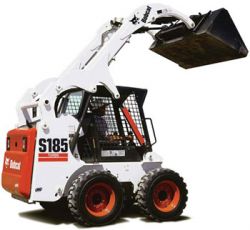
BOBCAT
Loader-Skid Steer 1850-2000lb Rental
- Model
- S185
- Weight
- 0.000
Request a quote for current pricing & availability.
Genuine OEMShips nationwideExpert support
With an extended, smooth-ride wheelbase, vertical lift path and 56 horsepower, the Bobcat® S185 (formerly the 773 Turbo) skid-steer loader is ideal for lift-and-carry operations as well as routine excavating tasks.
Rated Operating Capacity (SAE): 1,850 lbs (840 kg)
Tipping Load: 3,900 lbs (1769 kg)
Travel Speed: 7 mph (11.3 kmh)
Pump Capacity: 6.7 GPM (63 L/min)
Pump Capacity - High Flow: 27 GPM (102 L/min)
Engine Make: Kubota
Engine Model: V2003-T-EB
Engine Fuel: Diesel
Engine Cooling: Liquid
Number of Cylinders: 4
Horsepower (SAE NET): 56 HP (41.8 kW)
Displacement: 122 cubic in. (2 L)
Fuel Tank: 23 gal. (87.1 L)
Length with Standard Bucket: 130.3 in. (3309 mm)
Width (with bucket): 68 in. (1727 mm)
Height: 76.3 in. (1938 mm)
Height to Bucket Hinge Pin: 118.2 in. (3002 mm)
Operating Weight: 5,808 lbs. (2635 kg)
Note: The following skid steer safety & operating information is intended as a basic guide only. Operators should thoroughly acquaint themselves with the "Owner/Operator's Manual" specific to the make and model they have rented. OSHA requires that an "Owner/Operator's Manual" be present in the cab of a rented skid steer. If the complete manual is not present in your rented skid steer, call your rental dealer immediately. BE SAFE! BE AWARE!
What should I check before starting the engine?
Check the following before starting the engine: Fuel and oil,
Hydraulic fluid,
Cooling system fluid,
Operator cab, seat belt and seat bar,
Lift arm and cylinder pivot points, and tires.
Follow the manufacturer's recommendations about how often to lubricate all the "lube" points.
What should I do when using a loader? Read, understand, and follow instructions in the manufacturer's operating manual and safety decals on the loader.
Know how to operate the equipment safely and be familiar with the location and function of all the controls.
Know how to load, tie-down, transport, and unload the loader safely.
Wear hearing and head protection.
Use the safety treads and grab handles to get on and off the loader.
Use seat bar and fasten seat belt.
Keep your feet on the pedals when operating the loader.
Use only approved attachments and buckets.
Keep other people away from work area.
Drive with caution and check behind you before backing up.
Carry bucket or attachments as low as possible.
Load, unload, and turn on level ground.
Go straight up and down slopes with the heavy end of the loader pointed uphill.
Turn off the engine before attempting any repairs or adjustments.
If the equipment is going to be left unattended for sometime, remove the ignition key.
Set the parking brakes on before getting off the seat.
Lower the bucket before dismounting from the loader.
What should I avoid when operating a loader? Do not use loader without an approved roll-over protection (ROP) and falling object protection (FOP) cab.
Do not exceed rated operating capacity.
Do not carry passengers.
Do not use the bucket lift people or use as a work platform.
Do not make sharp, fast turns or move bucket controls abruptly.
Do not travel or turn with lift arms up.
Do not leave loader with engine running or with lift arms up.
Do not travel across a slope: go straight up or down slopes with the "heavy" end of the loader pointed uphill.
Do not approach overhead wires.
How should I go up and down a slope with a full bucket?
Keep the heavy end up!
How should I go up and down a slope with an empty bucket?
Keep the heavy end up!
What kind of loaders does this information apply to?
This information applies to smaller, front-end loaders called skid steer loaders. "Smaller" is a relative term; compact is another name for smaller loaders. Different manufacturers may rate their loaders up to 40 - 80 horsepower (or about 30 - 40 kW) as compact loaders. Some manufacturers use the term "compact loader" to mean what is usually called a skid steer loader or skidsteer loader used in landscaping. More commonly, "compact loader" refers to an articulating wheel loader; i.e., a loader that has two sections connected by a flexible joint and that can be steered by "bending" at the joint. Although many of the main safety principles for skid steer loaders apply to articulating wheel loaders, there are additional safety practices that relate to the operation and maintenance of articulated vehicles that are not covered in this document.
BOBCAT service & parts manuals
- Bobcat Co. 2200D
- Bobcat Co. 324M
- Bobcat Co. 331 G
- Bobcat Co. E26
- Bobcat Co. E50
- Bobcat Co. T590
- Bobcat Co. T630
- Bobcat Co. S630-N
- Bobcat Co. V518 VersaHandler
- Bobcat Co. T190 Compact Track Loader
- Bobcat Co. Bobcat S150 Skid Steer
- Bobcat Co. S185 Loader Skid Steer
- Bobcat Co. 341 Compact/Mini Excavator
- Bobcat Co. 334 Compact/Mini Excavator
- Bobcat Co. 328 Compact/Mini Excavator
- Bobcat Co. 337 Compact/Mini Excavator
- Bobcat Co. 331E Compact/Mini Excavator
- Bobcat Co. 331 Compact/Mini Excavator
- Bobcat Co. 325 Compact/Mini Excavator
- Bobcat Co. 322 Compact/Mini Excavator